AI Begins Reshaping How Uganda Markets and Delivers Tourism
Uganda’s tourism industry is being urged to embrace artificial intelligence (AI) and digital technologies as the sector seeks to transform how the country is marketed, discovered and experienced by travellers.
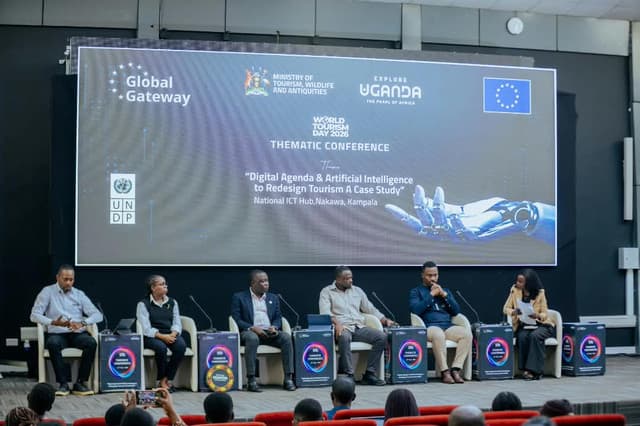
Tourism and hospitality leaders made the call at the World Tourism Day 2026 Thematic Conference held at the National ICT hub in Nakawa, Kampala under the theme “Digital Agenda and Artificial Intelligence to Redesign Tourism.”
The conference brought together government officials, tourism associations, technology innovators and industry players to examine how AI can influence destination marketing, tourism businesses and the visitor experience.
At the centre of the discussions was a changing traveller whose journey increasingly begins online, with AI tools becoming part of how people search for destinations, compare experiences, plan itineraries and make travel decisions.
Arthur Lwamafa, Senior Marketing Officer – Domestic and Regional Markets at the Uganda Tourism Board (UTB), said Uganda must begin thinking beyond traditional search engine visibility and consider how the country appears in AI-generated travel recommendations.
“The traveller is no longer just searching. The traveller is asking AI. Destination marketing is moving from simply being visible on search engines to becoming discoverable and recommendable through artificial intelligence,” Lwamafa said.
He said Uganda already has a wide range of tourism products, including wildlife, primates, adventure, culture, landscapes and the Nile, but the challenge is ensuring that this information is accurate, structured, current and accessible to both travellers and digital systems.
According to Lwamafa, the country needs a trusted tourism information ecosystem containing destinations, attractions, accommodation facilities, tour operators, guides, events, itineraries, entry requirements, transport information and verified tourism businesses.
He argued that AI could help UTB move from a general “Visit Uganda” message to more personalised destination marketing.
A traveller interested in birding, for example, could receive information tailored to birding experiences, while an adventure traveller could be directed towards activities such as rafting on the Nile, hiking the Rwenzoris and gorilla trekking.
Lwamafa also proposed an AI-powered Explore Uganda Travel Companion that could allow visitors to ask questions, develop itineraries, identify verified tourism businesses, find accommodation and discover experiences based on their interests, budget and available time.
The proposal builds on the existing Explore Uganda digital platform, which provides information about tourism products and services.
He said the future of tourism marketing would increasingly depend on the ability of destinations to organise and present their information in ways that both humans and AI systems can understand.
“The new destination-marketing question is no longer only: Are we searchable? It is: Are we recommendable by AI?” he said.
Natasha Agaba, Senior Digital Marketeer at UTB, cautioned that the growing use of AI should not lead people to surrender their judgement to technology.
She said AI remains a tool that requires human oversight because its responses are not always accurate.
“AI is meant to be something that you work on. In fact, if anything, it is not supposed to do everything for you,” Agaba said.
She encouraged tourism professionals, journalists and other users to challenge AI-generated information rather than simply accepting and reproducing it.
“AI is not always right. It is basically not always accurate, so it is something you have to question,” she said.
Agaba also challenged institutions to ensure that credible Ugandan information is available in formats that AI systems can access and understand.
“If we, as a country and as different entities and institutions, could teach AI, then we could help change that narrative,” she said.
She explained that institutions must provide accurate information about their work and tourism products so that AI tools do not rely on incomplete or inaccurate information when responding to questions about Uganda.
Agaba further emphasised that AI should complement human knowledge rather than replace it.
Dennis Ntege, representing the Uganda Tourism Association (UTA) , and serves as the Secretary General of the Association of Uganda Tour Operators(AUTO) said AI should be viewed as a means of improving existing tourism businesses rather than replacing the people behind them.
“AI is just a means to an end,” Ntege said.
He said tourism businesses already understand their products and experiences, and AI should help them communicate, market and deliver those products more efficiently.
He also highlighted the importance of human interaction, particularly in hospitality, where visitors ultimately seek real experiences and relationships.
“With tourism, we serve an experience and we serve a story. All this, even with AI, cannot replace the human element,” he said.
Ntege said AI can also help businesses respond to customers faster, particularly where international time zones create delays in communication.
However, he cautioned businesses to use their own knowledge to assess whether AI-generated information accurately represents the experience being offered.
Brian Ahereza, representing the Association of Uganda Tour Operators (AUTO), echoed the need for tourism businesses to embrace digital tools while maintaining the human element of tourism.
Government pushes digital tourism
Doreen Katusiime, the Permanent Secretary in the Ministry of Tourism, Wildlife and Antiquities represented by the Under Secretary at the event said the digital transformation of tourism must extend beyond destination marketing into conservation, visitor services and tourism operations.
She said Uganda was moving towards the use of AI-powered surveillance for wildlife tracking and park security, digital content hubs for destination marketing and predictive analytics to better understand visitor movements and promote lesser-known tourism destinations.
The Permanent Secretary also highlighted the digital divide affecting small and medium tourism enterprises.
She said “smart tourism should not be exclusive to major hotels and established tour operators. Community-based tourism initiatives and small businesses must also be able to participate in the digital marketplace.”
The ministry, she said, was working with partners to build skills among young people, tour guides and conservationists so they can participate in the emerging digital tourism economy.
The conference discussions pointed to a tourism industry where the journey increasingly begins before the visitor arrives physically in Uganda.
AI can potentially help travellers discover destinations, compare experiences, develop itineraries and obtain information, while tourism businesses can use the technology for marketing, communication, translation, content development and operational efficiency.
But speakers repeatedly stressed that technology should not replace the authenticity of Uganda’s tourism product.
For UTB, the emerging opportunity is to combine Uganda’s existing tourism assets with reliable data, digital infrastructure, artificial intelligence and human creativity.
As Lwamafa put it, “AI should not manufacture the Pearl of Africa. It should make the Pearl of Africa easier to discover.”
The challenge now is to ensure that as the global traveller increasingly turns to AI for answers, Uganda has the information, infrastructure and digital presence needed to be part of that conversation.