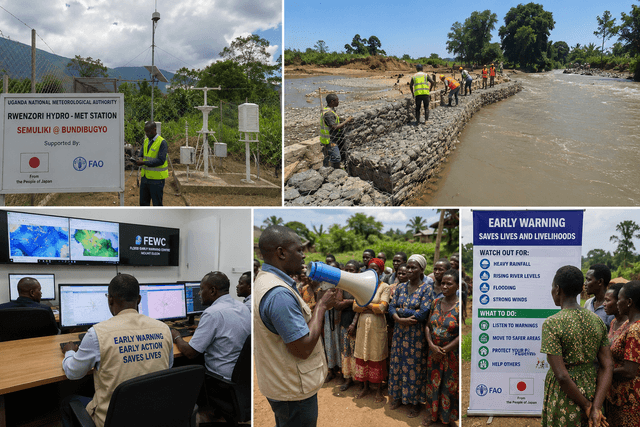
Ministry of Water and Environment and Partners Verify Climate Resilience Project Impact in Eastern Uganda
By our Reporter
A joint team from Uganda’s Ministry of Water and Environment, district officials from Bulambuli and Sironko, and an independent Italian consultancy firm has concluded a three-day field verification exercise assessing the progress and impact of a climate resilience project under implementation in eastern Uganda.
The verification mission, conducted in Bulambuli and Sironko districts, focused on the Ecosystem-based Adaptation (EbA) Project, a government-led initiative aimed at reducing climate change vulnerability among local communities through sustainable management of wetlands and forest ecosystems.
The consultancy firm, Timesis SRL, was contracted by the United Nations Environment Programme (UNEP) to provide an independent assessment of the project’s performance against its key indicators, as outlined in the project’s logical framework.
According to the Ministry of Water and Environment, the verification exercise is critical in evaluating whether the project is delivering on its intended environmental and socio-economic outcomes.
“The verification exercise is an important step in assessing the implementation progress of the Ecosystem-based Adaptation Project and ensuring that the interventions are yielding measurable impact for communities and ecosystems,” the Ministry said in a statement shared on its official platforms.
The EbA Project—formally titled “Reducing the Climate Change Vulnerability of Local Communities in Uganda through Ecosystem-based Adaptation in Wetland and Forest Ecosystems”—is being implemented through the Ministry’s Department of Environment Sector Support Services. It is financed by the Global Environment Facility (GEF), with technical support from UNEP.
The project is currently being implemented across four critical ecosystems in Uganda: River Enyau, River Sironko, River Rwizi, and River Rwambu-Mpanga.
In Sironko District, where riverbank degradation had become a growing concern, the project targeted farmers who had been encroaching on fragile ecosystems. These farmers were mobilized into 19 organized groups; nine in Bulambuli and ten in Sironko—bringing together a total of 415 smallholder farmers.
Through the project, the farmers have received training in climate-smart agricultural practices and alternative livelihood options aimed at reducing pressure on natural ecosystems. These include piggery, goat rearing, poultry farming, and the cultivation of high-value crops such as vegetables, maize, and soybeans.
Additionally, beneficiaries have been equipped with skills in soil conservation along riverbanks, agroforestry, construction of energy-saving stoves, and financial literacy, including savings and credit management. Gender awareness has also been integrated into the training to ensure inclusive participation and benefits.
Officials say these interventions are not only restoring degraded ecosystems but also improving household incomes and resilience to climate shocks.
Preliminary findings from the verification exercise indicate that the Ecosystem-based adaptation (EbA) project is largely on track in meeting its intended objectives, with notable progress in reducing pressure on fragile riverbank ecosystems and improving community resilience. The assessment found that the majority of smallholder farmers are adopting climate-smart agricultural practices and alternative livelihoods, leading to decreased encroachment on the Sironko River banks. The establishment of farmer groups, combined with training in soil conservation, agroforestry, and financial literacy, promise to strengthen both environmental stewardship and household income stability. However, the verification team noted the need for continued technical support, closer monitoring of long-term ecosystem restoration outcomes, and scaling of successful interventions to sustain gains and enhance impact across all project sites.
The Ministry emphasized that such ecosystem-based approaches are essential in addressing the growing impacts of climate change, particularly in vulnerable rural communities that depend heavily on natural resources for their livelihoods.
The findings from the verification exercise are expected to inform future programming, scaling strategies, and policy direction for climate adaptation initiatives in Uganda.