Powered by the sun: Ugandan farmers turn to solar irrigation amid climate crisis
By Joshua Kagoro
In the dry heat of Bardege-Layibi Division in Gulu, rows of green cabbage and thriving vegetable gardens now stretch across land that once cracked under prolonged drought.
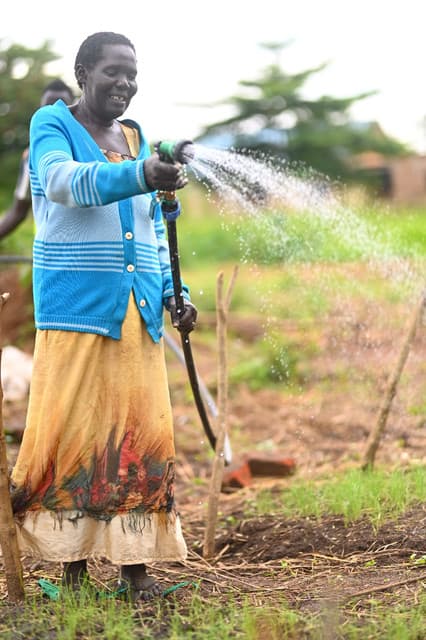
Water flows steadily through pipes into Joyce Ochen’s fields, nourishing crops that no longer wait anxiously for the rains. Just a few years ago, this same farm stood on the brink of collapse, battered by climate shocks, illness, and personal loss.
Today, it stands as a symbol of resilience and a glimpse into what climate smart agriculture could look like for thousands of farmers across Uganda.
After retiring in 2013, Joyce and her husband invested their savings in farming. They ventured into dairy farming before later expanding into vegetable production, growing tomatoes, cabbage, eggplants, and sukuma wiki.
However, year after year, drought wiped out their crops.
Then came a severe spinal illness that temporarily left her paralysed. In 2018, she lost her husband, forcing her to continue the journey alone.
Her story now reflects the growing impact of the Pump-Up Project, an initiative funded by DANIDA (Danish International Development Agency) and the Danish Ministry of Foreign Affairs and implemented by Mercy Corps in partnership with Tulima Solar and Simusolar to expand access to solar powered irrigation systems among smallholder farmers.
Nexus News Africa traced Joyce’s journey to understand the realities behind the project and the wider national push toward climate resilient agriculture, as highlighted in Mercy Corps’ new report supporting Uganda’s Nationally Determined Contributions (NDC 3.0) and other adaptation priorities.
“I was bedridden and wondering if farming was over for me,” she recalls.
A turning point came in 2024 while she was listening to a radio talk show. She heard about a partnership between Mercy Corps and Tulima Solar offering affordable solar irrigation solutions.
She immediately made the call.
A field assessment later revealed that her well, which was the farm’s main water source, was too shallow.
Determined not to give up, she mobilised her children and pooled resources to drill a deeper borehole and construct a 10,000 litre water tank, overseeing the process while still recovering physically.
Within a week of installation, water flowed.
“When the pump first switched on, I knew drought would never kill my crops again,” she said.
Today, her farm produces throughout the year. Cabbages fetch over UGX 2,000 each, while pig farming has expanded due to the reliable water supply.
Crop residues now feed livestock, and manure improves soil fertility, doubling yields of maize and beans.
As a result, her farm has become a demonstration site, attracting agriculture students and earning recognition under the Parish Development Model as a benchmark for climate smart agriculture.
CONFRONTING THE CHALLENGE
Uganda’s agricultural sector, the backbone of its economy and the primary source of livelihood for nearly 70 percent of the population, is under growing threat.
Erratic rainfall, prolonged dry spells, and shifting planting seasons are no longer distant warnings. They are lived realities. Over time, climate-related shocks have already shaved off between 1 to 7 percent of the country’s GDP, largely through reduced agricultural productivity.
Yet, even with an estimated three million hectares of irrigable land, only about one percent is currently under irrigation.
This gap, both a vulnerability and an opportunity, formed the centerpiece of discussions at the Uganda National Investment Forum on Solar-Powered Irrigation Systems held in Kampala this week.
Convened by the United Nation Environment Programme (UNEP) Copenhagen Climate Centre in partnership with Food and Agriculture Organization, Global Green Growth Institute, United Nations Capital Development Fund and Mercy Corps, the forum brought together policymakers, private sector actors, financial institutions and farmers to chart a path forward.
At the heart of the conversation was one solution increasingly seen as both practical and transformative—Solar-Powered Irrigation Systems (SPIS).
A TECHNOLOGY WHOSE TIME HAS COME
Solar-powered irrigation systems harness sunlight through photovoltaic panels to generate electricity that drives water pumps, drawing water from boreholes, wells, or surface sources.
These systems can produce between 6,000 and 30,000 liters of water daily, allowing farmers to irrigate crops consistently, regardless of rainfall patterns.
More importantly, once installed, they eliminate recurring fuel costs and reduce exposure to fluctuating energy prices.
Evidence presented at the forum shows that when combined with climate-smart agricultural practices, SPIS can increase yields of high-value crops such as tomatoes, cabbage, and watermelon by between 150 - 250 percent.
They enable off-season production, reduce crop losses, and stabilise incomes for smallholder farmers.
In many cases, farmers are able to recover their investment within one production season under flexible financing arrangements.
“This is not just a technology. it is a strategic response to food security,” said Martin Ameu, the Assistant FAO Representative, in charge of Programme.
Uganda is not starting from scratch.
Pilot interventions, including the Pump-Up project, have already demonstrated the viability of solar irrigation at scale.
The Pump-Up Project, short for Powering the Uptake of Climate Change Mitigating Pumps, has adopted a market systems development approach, working with private sector actors, financial institutions, agro-input dealers and farmer cooperatives.
Through demonstration sites, farmers are able to see, touch, and understand how irrigation systems work before making purchasing decisions.
They are then supported with training in modern agronomic practices, linked to input suppliers, and connected to off-takers, therefore creating a complete value chain from production to market.
To date, more than 1,000 farmers have adopted solar irrigation systems through the programme—over 530 directly within project districts, and nearly 490 in indirect districts reached through radio campaigns and outreach initiatives.
“The objective is not just to sell equipment. We provide solutions understanding the farmer’s needs, their land size, their experience, and then offering the right system, ” said Lawrence Otim, Programme Manager of the Pump-Up Project.
The systems themselves vary from small surface pumps suitable for half-acre plots to larger installations capable of supporting up to five acres.
THE FINANCING CHALLENGE
Despite clear success stories, one major barrier persists—affordability.
Solar irrigation systems require significant upfront investment, often beyond the reach of smallholder farmers.
At the forum, officials from the Ministry of Finance, planning, and economic development (MoFPED) acknowledged this challenge.
“The question is not whether the technology works. The question is whether it is affordable enough for the smallholder farmer to adopt,” said James Muhwezi, senior Climate Finance officer, MoFPED.
To address this, innovative financing models are being introduced, including pay-as-you-go arrangements, lease-to-own schemes, seasonal financing aligned with harvest cycles, and group-based lending where farmer cooperatives act as collateral.
These models are designed to align repayment with agricultural cash flows, reducing financial pressure on farmers.
However, Uganda’s broader climate financing gap remains significant.
The country requires an estimated $28.1 billion ( $17.7Bn adaptation, $10.3Bn mitigation, and $0.1Bn cross-cutting) by 2030 to fully implement its climate commitments, yet currently mobilises only about 3.9 percent of that amount.
On July 10, 2025, Uganda, led by the MOFPED’s climate finance unit, launched the first National Private Sector Engagement Forum on Climate Finance to mobilize, unlock private capital and bridge the gap & lead climate solutions.
GOVERNMENT AND PARTNERS COMMIT
Recognising the urgency, the government is stepping in with policy and financial reforms aimed at scaling solar irrigation.
Commitments include integrating SPIS into national investment plans, applying climate budget tagging, establishing quality standards, and developing risk-sharing mechanisms to encourage private sector lending.
There are also plans to introduce fiscal and non-fiscal incentives to accelerate adoption.
Solar irrigation is already prioritised in key national frameworks, including the National Adaptation Plan, Nationally Determined Contributions, and the Fourth National Development Plan, which targets 1.5 million hectares under irrigation by 2040.
Development partners are also reinforcing their support.
Through initiatives such as the Danish-funded Green Business Partnerships, efforts are underway to build a market-driven ecosystem that connects farmers, investors, and technology providers.
“This is about moving from pilots to scale. We must ensure solar irrigation becomes a standard, not a luxury,” said Adam Spliid, Deputy Head of Mission and Head of Cooperation at Denmark's embassy in Uganda.
BEYOND TECHNOLOGY: A SYSTEM SHIFT
Experts emphasise that solar irrigation is not just about water. It intersects with climate adaptation, energy access, and economic transformation.
Bob Natifu, Acting Commissioner for Climate Change at the Ministry of Water and Environment, says Uganda’s average temperatures have already risen by approximately 1.3 degrees Celsius since 2000, increasing rainfall variability and agricultural risk.
“It tells us that we still have a lot to do if we are to improve farming activities. This increase is driving variability, and that has implications for our entire agricultural system,” he said.
For Natifu, the issue is not just about heat but about instability.
“It just shows that we’re going to increase the variability, and that is going to cause structural shifts and challenges for us to deal with,” he added.
At the same time, rural energy access remains limited, making decentralised solar solutions particularly relevant.
By replacing diesel pumps, SPIS reduces emissions while lowering operational costs for farmers.
But scaling the technology requires more than equistrate. It requires coordinated systems.
Aggregator-based models involving cooperatives, SACCOs, and agribusinesses are emerging as a key strategy.
These structures aggregate demand, improve credit access, provide training, and strengthen market linkages—making adoption more inclusive and sustainable.
THE ROAD AHEAD
High upfront costs, limited financing, weak last-mile service networks, maintenance gaps, and water source reliability continue to constrain adoption.
There are also risks of theft and vandalism of solar panels, as well as limited technical expertise in Uganda’s remote areas.
Yet, stakeholders agree that the biggest barrier is no longer viability but coordination.
Stakeholders also urge that by aligning policy frameworks, public finance, and private investment, Uganda has the potential to unlock large-scale adoption of solar irrigation.
A FUTURE POWERED BY THE SUN
Back in Gulu, Joyce Ochen walks through her fields, inspecting crops that no longer depend on the rain.
Her produce sales now cover medical expenses and school fees.
Students learn on her farm. The uncertainty that once defined her livelihood has been replaced with stability.
“There is almost nothing we lack now,” she said.
If commitments made in Kampala are matched with action, solar-powered irrigation could move from scattered interventions in selected few districts to a nationwide transformation, reshaping agriculture, strengthening resilience, and turning one of Uganda’s most abundant resources—the sun—into a reliable engine of growth.