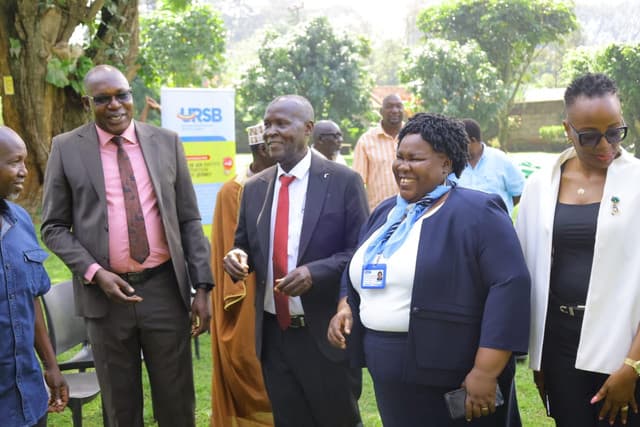
MBALE — In a move aimed at simplifying how organisations are identified and supported across Uganda, the Uganda Registration Services Bureau (URSB) has begun engaging local governments on the rollout of the Non-Individual Register (NIR), starting with leaders in Eastern Uganda.
The first engagement was held on Tuesday, May 5, 2026, at Mount Elgon Spa and Hotel in Mbale, bringing together Chief Administrative Officers, District Commercial Officers, and District Community Development Officers from across the Bugisu sub-region — including Mbale, Manafwa, Bududa, Sironko, Bulambuli, and Namisindwa districts.
For many of the local officials in attendance, the meeting marked more than just a technical briefing. It was an opportunity to better understand a system that could directly impact how businesses, cooperatives, and community organisations in their districts are registered, tracked, and supported.
Speaking on behalf of Registrar General Mercy K. Kainobwisho, Commissioner for Finance and Administration Ambrose Ekaju described the rollout of the NIR as a turning point in how Uganda manages information on institutions beyond individuals.
He explained that the Non-Individual Register will serve as a single, centralised repository for all entities operating in Uganda — both business and non-business — including companies, partnerships, associations, non-governmental organisations, and cooperatives.
“For a long time, entities have been registered across multiple agencies, resulting in fragmented data, duplication, and inefficiencies,” Ekaju said. “The Non-Individual Register addresses these challenges by creating a unified system that enhances coordination, improves compliance, and simplifies access to services.”
At the heart of the initiative is a practical concern shared by many local governments: the difficulty of tracking and supporting organisations due to scattered and inconsistent records. By consolidating this information, URSB hopes to equip district leaders with clearer visibility of economic and social actors within their jurisdictions.
The Registrar General also emphasized the need for collaboration, calling on government agencies, the private sector, civil society, and development partners to support the rollout. Local governments, she noted, will play a critical role in ensuring awareness, compliance, and adoption at community level.
She reaffirmed URSB’s commitment to supporting stakeholders throughout the transition. “We will continue providing guidance, building capacity, and ensuring that the system is accessible, efficient, and responsive to your needs,” she said.
The Guest of Honour, Mbale City Resident City Commissioner George William Wopuwa, placed the initiative in a broader policy context. He informed participants that the establishment of the Non-Individual Register follows the amendment to Section 4 of the Tax Procedures Code (Amendment) Act, 2025.
Under the law, the Government of Uganda has mandated URSB to establish and maintain a central repository of information on all non-individual entities registered, incorporated, or operating in the country — positioning the Bureau at the centre of efforts to improve transparency, coordination, and access to reliable data.
Wopuwa commended URSB for its continued efforts to improve accessibility and efficiency in registration services, expressing confidence that the new register will deliver tangible benefits for both government and citizens.
As discussions concluded, one message stood out clearly: the success of the Non-Individual Register will not only depend on technology, but on how well local governments and communities embrace it — making them key players in shaping a more coordinated and transparent system for Uganda’s institutions.