Lubigi Wetland Restoration Raises Tough Questions on Enforcement, Fairness
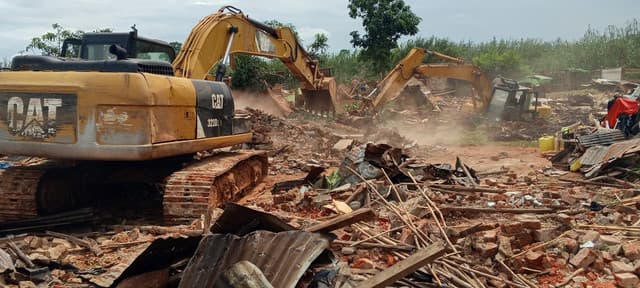
The National Environment Management Authority (NEMA) has concluded a fresh restoration exercise in the degraded Lubigi Wetland system, demolishing dozens of illegal structures and reclaiming close to 25 acres of wetland in Kampala’s Kawaala area.
But even as environmentalists welcomed the move as long overdue, the operation has again exposed deep public frustration over what many describe as selective enforcement against the poor while powerful businesses remain untouched inside protected wetlands.
In a statement issued Friday, NEMA said the restoration exercise followed the expiry of a voluntary relocation grace period issued in 2025 to people illegally occupying sections of the wetland. The operation, conducted jointly with the Wetlands Management Department under the Ministry of Water and Environment, local governments, Uganda Police Force and the UPDF, led to the demolition of 58 illegal structures in Kawaala Zone, Rubaga Division.
The Authority described the operation as necessary to restore one of Kampala’s most critical ecosystems.
“The restoration of Lubigi Wetland is expected to yield significant environmental and public benefits, including improved flood control, enhanced water filtration, biodiversity conservation, climate regulation, and improved public health and sanitation,” NEMA said.
Lubigi Wetland plays a major ecological role for Kampala Metropolitan Area. Besides acting as a natural flood buffer during heavy rains, the wetland filters pollution, recharges underground water systems and supports biodiversity including the endangered Grey Crowned Crane, Uganda’s national bird.
Authorities say unchecked encroachment has over the years degraded large sections of the wetland through illegal settlements, dumping, industrial activities and construction.
NEMA said most affected residents complied peacefully and were allowed time to remove their property before demolitions commenced. No injuries or fatalities were reported, although five people were arrested for allegedly resisting and mobilising others against the operation.

The Authority further warned that restoration exercises will continue in other degraded wetlands including Kaliddubi and Kyetinda.
However, despite the environmental justification behind the operation, the demolitions have triggered renewed criticism from sections of the public who accuse government agencies of targeting vulnerable residents while politically connected businesses continue operating inside wetlands with little interference.
Much of the criticism has centered on the continued presence of large commercial establishments within Lubigi Wetland, particularly the controversial Stabex fuel station and depot along Hoima Road in Nansana.
Social media platforms especially X (formerly twitter) were flooded with reactions questioning why small residential structures were demolished while major investments remain standing.
“Performative nonsense. If you’re serious no factory would be standing in Namanve. Picfare’s fence literally floods,” one commenter wrote.
Others questioned whether influential enterprises in wetlands would ever face similar action.
“Will you also demolish the enterprises that are in the wetlands?” another member of the public asked.
NEMA has previously defended the exemption of the Stabex facility, arguing that the company acquired approvals from government agencies before construction and that the land had already been heavily altered during road works.
But critics argue that explanation exposes wider failures within Uganda’s environmental governance system, where approvals are often issued by state institutions only for ordinary citizens to later bear the consequences of enforcement actions.
Environmental activists and urban planners say the controversy reflects a broader national challenge: balancing environmental restoration with accountability, urban poverty and institutional consistency.
Others are now demanding that government publicly release updated wetland maps and gazetted boundaries to eliminate ambiguity and prevent future encroachment disputes.
“As these evictions continue, can government publish GIS maps showing all gazetted wetlands down to the last administrative unit?” one X user asked.
Questions have also emerged over whether Uganda recognizes artificial or man-made wetlands and how such ecosystems are protected under existing environmental laws.
Under Section 55 of the National Environment Act, wetland degradation remains a criminal offence punishable by fines or imprisonment of up to 12 years.
Yet for many observers, the future credibility of Uganda’s wetland restoration campaign may not only depend on demolishing informal structures, but also on whether enforcement is applied consistently across both ordinary citizens and powerful investors.
With Kampala increasingly experiencing destructive flooding linked to wetland degradation and climate change, pressure is mounting on authorities to prove that environmental protection is not selective, but guided by science, law and public interest.