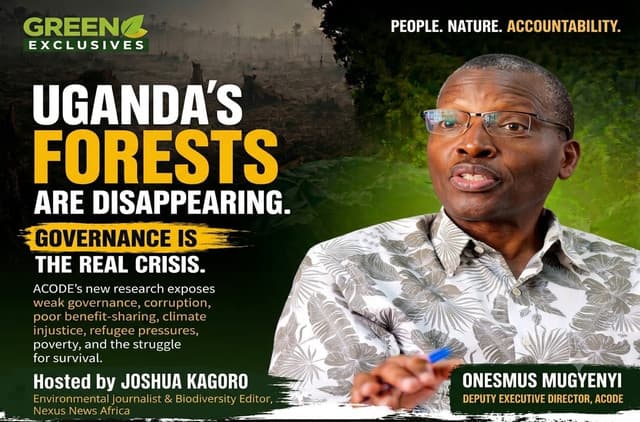
Uganda's forests are disappearing at a pace that is increasingly alarming conservationists, scientists and policymakers alike.
Behind every hectare lost lies a web of governance failures, weak law enforcement, corruption, poverty, climate change, inadequate financing, and communities struggling to survive.
Recent policy briefs released by the Advocates Coalition for Development and Environment (ACODE) paint one of the clearest pictures yet of the challenges facing Uganda's forests, particularly in the vulnerable landscapes of West Nile and Karamoja.
The research, conducted under ACODE's Strengthening Civic Engagement, Voice, Service Delivery and Climate Justice for Improved Accountability in Uganda project, found that although Uganda has developed strong forest policies over the years, implementation remains painfully weak.
In West Nile, where more than 1.5 million refugees have settled, forests such as Zoka and Agoro-Agu continue to face mounting pressure from commercial charcoal production, illegal logging, tobacco curing, agricultural expansion and growing demand for firewood and construction materials. ACODE estimates that Zoka Forest lost nearly 40 percent of its forest cover between 2001 and 2015, while annual deforestation rates in parts of West Nile stand at 3.2 percent, significantly above Uganda's national average of 2.1 percent.
Karamoja presents a different but equally troubling picture. Prolonged droughts, wildfires, overgrazing, expansion of cultivation, charcoal burning and competition over scarce natural resources continue to degrade landscapes such as Timu and Murungole Central Forest Reserves, where some areas have lost nearly 25 percent of forest cover over the last decade.
Yet beyond the statistics, ACODE argues that Uganda's biggest environmental crisis is not simply disappearing forests—but failing governance systems.
In this edition of Green Exclusives, Environmental Journalist Joshua Kagoro sat down with Onesmus Mugyenyi, Deputy Executive Director of ACODE, to unpack the research findings, explain why conservation is failing many local communities, and discuss what must change if Uganda is to protect its forests while improving livelihoods.
Q: For someone who has not read ACODE's policy briefs, what exactly did your research find in West Nile and Karamoja?
Onesmus Mugyenyi: At its core, our research examined two interconnected issues—natural resource governance and climate justice.
The findings confirm what many reports have already suggested: Uganda continues to lose forests at an alarming rate. But what stood out most during our field engagements wasn't simply the degradation itself. It was the disconnect between communities and conservation.
One of the strongest findings was that inclusive conservation is largely missing.
Communities living closest to forests are not meaningfully participating in protecting them. Many people no longer see forests as resources that directly sustain their livelihoods, which means their willingness to conserve them continues to decline.
Over the years Uganda has developed policies, laws and awareness campaigns around climate change and forest conservation. Yet despite all these interventions, citizen participation remains remarkably low.
Another major finding concerns benefit-sharing.
Many communities believe they shoulder the burden of protecting forests without receiving equitable benefits in return.
Yes, forests provide indirect benefits such as rainfall regulation, carbon storage and climate regulation that everyone enjoys. But communities living beside these forests expect tangible benefits that improve their daily lives.
Unfortunately, those benefits remain limited, creating frustration and weakening conservation efforts.
Q: What surprised you most during the research?
Mugyenyi: The biggest surprise was discovering just how limited community ownership of conservation has become.
You would expect that after decades of environmental awareness campaigns, communities would feel deeply connected to forest protection.
Instead, we found that many citizens still feel excluded from decision-making.
Conservation cannot succeed if local people remain spectators. They must become genuine partners.
That gap between policy intentions and community participation was perhaps our most striking finding.
Q: Your report frequently refers to climate justice. What does climate justice actually mean to an ordinary farmer, pastoralist or community member?
Mugyenyi: Climate justice is really about fairness.
It evolved from the broader concept of environmental justice.
The communities suffering the worst impacts of climate change are often those who contributed the least to causing it.
Large industries and developed economies have historically produced the greatest greenhouse gas emissions. Yet it is rural farmers, pastoralists, women, refugees and poor communities that bear the greatest burden through prolonged droughts, crop failures, floods and food insecurity.
Climate justice asks an important question:
When governments allocate climate finance, adaptation resources or resilience programmes, are they prioritising the people who are most vulnerable?
Too often, they are not.
Climate justice therefore means ensuring that those who contribute least to climate change receive the greatest support in adapting to its impacts.
Q: Why should an ordinary Ugandan living hundreds of kilometres away care about forests in West Nile or Karamoja?
Mugyenyi: Because forests do not serve only the communities that live beside them.
Their ecological services extend far beyond district boundaries.
Forests absorb carbon dioxide, regulate rainfall, stabilise temperatures and protect biodiversity.
When forests disappear in Karamoja or West Nile, the effects are eventually felt across Uganda.
Drought does not recognise district boundaries.
Climate change does not stop at regional borders.
Every Ugandan therefore has a stake in protecting these forests because they are part of a national ecological system that supports agriculture, water security, public health and economic development.
Q: Your report repeatedly points to governance failures. Who exactly is failing Uganda's forests? Government, local leaders, communities—or everyone?
Mugyenyi: Governance is much broader than government alone.
Good governance involves transparency, accountability, citizen participation, effective institutions and proper enforcement of laws.
From that perspective, multiple actors share responsibility.
Government has the responsibility to develop laws, enforce regulations, allocate budgets and create awareness.
But enforcement remains weak.
Local governments often lack adequate funding and technical capacity.
Citizens also have responsibilities.
They should demand accountability and participate in protecting natural resources.
However, many communities lack access to information that would enable them to effectively hold leaders accountable.
Civil society organisations play an important role in awareness creation, but most operate through short-term projects.
When project funding ends, many interventions disappear.
Government is the only institution capable of sustaining nationwide conservation programmes over the long term.
Q: You mention governance failures, but isn't corruption really the elephant in the room?
Mugyenyi: Absolutely.
Sometimes we hide corruption behind the broader word "governance."
But corruption is one of Uganda's biggest obstacles to effective environmental protection.
When law enforcement officers fail to enforce environmental laws because of corruption, forests suffer.
When institutions responsible for prosecution fail to secure justice, illegal activities continue.
When political leaders interfere with enforcement or fail to support implementation, the entire governance system weakens.
Environmental governance depends on institutions working together.
The Executive develops policies.
Parliament enacts laws.
The Judiciary administers justice.
Enforcement agencies implement the law.
If any one of those institutions fails because of corruption, the entire system becomes ineffective.
That is why corruption remains one of the greatest threats to Uganda's forests.
Q: Communities told your researchers they receive very few benefits from conservation. Has conservation become a bad business deal for local people?
Mugyenyi: Modern conservation depends on community participation.
But participation requires incentives.
Communities must see that protecting forests improves their livelihoods.
Unfortunately, many benefit-sharing arrangements remain inadequate.
Unlike wildlife conservation, where neighbouring communities receive a share of tourism revenue, forestry offers very limited direct financial incentives.
That imbalance discourages participation.
Yet opportunities exist.
For example, emerging carbon markets now generate revenue from forest conservation.
Communities protecting these forests should receive a fair share of those benefits.
Other opportunities include sustainable harvesting of non-timber forest products, beekeeping, agroforestry and ecotourism.
When communities benefit fairly, they become active custodians rather than reluctant observers.
Q: Some communities say illegal charcoal burning and logging pay far more than legal conservation initiatives. Doesn't that suggest conservation is economically unrealistic?
Mugyenyi: Illegal activities provide quick money because they require very little investment.
Someone enters a forest, cuts trees, burns charcoal or harvests timber and earns immediate income.
Conservation works differently.
Activities like beekeeping, tree planting or agroforestry require investment, patience and management before returns are realised.
Illegal exploitation may appear more profitable in the short term, but it destroys the very resource people depend on.
It is neither sustainable nor lawful.
The challenge is ensuring that legal livelihood alternatives become attractive enough to compete with destructive activities.
Q: If you were to summarise ACODE's findings in one message, what would it be?
Mugyenyi: Uganda does not lack environmental policies.
We have many.
Our greatest challenge is ensuring that governance systems actually work.
If communities are empowered, corruption is tackled, laws are enforced consistently and benefit-sharing becomes fair, Uganda can still reverse forest loss.
But without those reforms, we risk losing forests that are essential not only for biodiversity but also for climate resilience, food security and the country's long-term development.
— End of Part I —
Part II
"Refugees Are Not the Problem—But They Have Increased the Pressure on Already Fragile Forests."
In Part II of this exclusive conversation, ACODE Deputy Executive Director Onesmus Mugyenyi discusses one of Uganda's most sensitive environmental debates—refugees and forest degradation. He also explains why Karamoja's environmental crisis is unlike any other in Uganda, why poverty alone cannot explain forest loss, and why the country must rethink conservation before climate change overtakes development.
Q: West Nile hosts one of the largest refugee populations in Africa. To what extent are refugee settlements contributing to forest degradation?
Onesmus Mugyenyi: There is no denying that refugee settlements have increased pressure on forest resources.
The evidence from our field engagements clearly points in that direction.
I may not be able to quantify the exact percentage of degradation attributable to refugees, but I can confidently say the pressure is substantial.
When large refugee populations arrive, the demand for basic necessities rises almost immediately. People need poles for shelter construction, firewood for cooking, timber for household use and land to sustain their livelihoods.
Naturally, the nearest forests become the primary source of those resources.
In West Nile, forest reserves neighbouring refugee settlements have experienced increasing pressure because they provide readily available building materials, fuelwood and other forest products.
Even where refugees themselves may not directly engage in charcoal production, their presence creates a growing market for charcoal.
That increased demand encourages commercial producers and illegal loggers to exploit forests more aggressively.
So the issue goes beyond individual actions. Population growth around forest landscapes inevitably increases demand for natural resources, and unless that demand is managed sustainably, forest degradation accelerates.
The challenge, therefore, is not refugees alone, but the absence of adequate systems to absorb that pressure without destroying the environment.
Q: Some people may hear your findings and conclude that refugees are destroying Uganda's forests. Is that a fair conclusion?
Mugyenyi: No.
That would be an oversimplification of a much more complex issue.
Uganda's forests were already under pressure long before the refugee influx.
Illegal logging, commercial charcoal production, agricultural expansion, weak law enforcement, corruption and inadequate forest management have all contributed to forest degradation for many years.
What refugee settlements have done is increase pressure on systems that were already struggling.
We should therefore avoid blaming vulnerable populations for problems rooted in governance failures.
Refugees need shelter.
They need energy.
They need food.
If planning for refugee settlements fails to integrate environmental protection, then forests inevitably suffer.
The responsibility lies in designing humanitarian responses that protect both displaced people and the ecosystems supporting them.
Q: Should Uganda's refugee response include stronger environmental safeguards and restoration investments?
Mugyenyi: Absolutely.
Environmental conservation cannot be treated as an afterthought.
Every refugee response programme should have a deliberate conservation component.
Government, the Office of the Prime Minister, development partners and humanitarian agencies have begun integrating environmental restoration into refugee programming.
That is encouraging.
But our research suggests the current efforts remain inadequate.
There is still a significant imbalance between population growth and investments in environmental restoration.
We need much larger investments in tree planting, alternative energy technologies, landscape restoration, agroforestry and sustainable natural resource management.
Unless environmental considerations become central to refugee planning, forests will continue to pay the price.
Q: Who should bear the cost of protecting forests in refugee-hosting districts—the Government of Uganda, development partners or the international community?
Mugyenyi: Ultimately, responsibility rests with the Government of Uganda.
Government has the constitutional obligation to protect the country's natural resources.
That responsibility cannot be delegated.
However, Uganda has also made an extraordinary humanitarian contribution by hosting one of Africa's largest refugee populations.
The international community therefore has a moral obligation to support those efforts.
Many industrialised countries have historically contributed far more to global greenhouse gas emissions than countries like Uganda.
They have made commitments under international climate agreements to finance climate adaptation and resilience.
Unfortunately, the financial support reaching countries like Uganda remains insufficient.
Government should continue leading conservation efforts while mobilising additional support from development partners, climate finance mechanisms and the international community.
Environmental protection in refugee-hosting districts should be viewed as a shared global responsibility.
Q: Are we asking already vulnerable host communities to carry an environmental burden that should be shared internationally?
Mugyenyi: Yes.
Host communities often bear enormous environmental and economic costs.
They share land.
They share water.
They share forests.
They share public services.
Yet the environmental burden rarely receives the same level of attention as humanitarian assistance.
Communities living alongside refugee settlements frequently experience declining forest resources, increased competition for firewood, reduced grazing areas and greater pressure on agricultural land.
Supporting refugees must therefore go hand in hand with supporting host communities.
Otherwise resentment grows, environmental degradation worsens and social tensions become more likely.
KARAMOJA: WHERE CLIMATE, POVERTY AND GOVERNANCE COLLIDE
Q: Karamoja appears to face different environmental challenges from West Nile. What are the key drivers of forest degradation there?
Mugyenyi: Karamoja is unique.
Its environmental challenges differ significantly from many other regions of Uganda.
The first factor is climate.
Karamoja experiences some of the country's longest and harshest dry spells.
During prolonged droughts, pastoral communities are forced to move livestock into wetlands, protected areas and forest reserves in search of water and pasture.
That places enormous pressure on already fragile ecosystems.
Secondly, Karamoja has historical land-use challenges.
Some indigenous communities have lived inside forest reserves for generations.
When many of these protected areas were gazetted, questions surrounding community rights and land ownership were never fully resolved.
Today, many families continue living inside or adjacent to forest reserves without clear legal recognition of their rights.
Population growth has only intensified that pressure.
As households expand, so does demand for agricultural land.
Yet much of Karamoja's productive land falls within protected areas.
That creates inevitable conflicts between conservation and survival.
Unlike West Nile, where refugee pressures dominate, Karamoja's challenges are deeply rooted in climate, historical land tenure issues and the realities of pastoral livelihoods.
Q: How much of what you're seeing in Karamoja is driven by climate change, and how much is simply poverty?
Mugyenyi: It is both.
Climate change and poverty reinforce one another.
However, I would caution against assuming poverty is the sole cause of environmental degradation.
Often, the biggest environmental destruction is caused by actors with significant financial resources.
Mining companies, commercial operators and organised illegal resource exploiters cannot be described as poor.
Poverty certainly contributes because vulnerable households sometimes rely heavily on forests for survival.
But degradation is also driven by commercial interests seeking profit.
That is why addressing poverty alone will never solve Uganda's environmental challenges.
Governance must also improve.
Q: Can conservation succeed where communities are struggling simply to survive?
Mugyenyi: Conservation cannot succeed if survival is ignored.
Communities facing hunger, drought and unemployment will naturally prioritise immediate needs.
That is understandable.
But conservation and livelihoods should never be treated as competing objectives.
They should reinforce one another.
Communities need economic opportunities that reward conservation rather than destruction.
When sustainable enterprises become profitable, conservation becomes part of local development instead of an obstacle to it.
That is the future Uganda should pursue.
Q: What lessons should the rest of Uganda learn from Karamoja?
Mugyenyi: Karamoja offers an important warning.
For many years, prolonged droughts were viewed as unique to that region.
Today we are witnessing similar climate patterns across much of Uganda.
Longer dry spells are becoming more frequent.
Water sources are shrinking.
Agricultural productivity is declining.
What has happened in Karamoja demonstrates what environmental degradation combined with climate change can do.
If Uganda continues losing forests elsewhere, other regions may begin experiencing similar ecological conditions.
The lesson is simple:
Protect forests before environmental decline reaches irreversible levels.
Waiting until landscapes collapse is far more expensive than preventing degradation in the first place.
By the midpoint of this exclusive conversation, one message had become unmistakably clear.
Uganda's forest crisis cannot be blamed on one institution, one community or one region.
It is the product of weak governance, limited financing, corruption, inadequate community incentives, climate change and competing development pressures.
Yet perhaps the most uncomfortable discussion was still to come.
Does Uganda really have a forest policy problem—or does it simply have an implementation problem?
End of Part II
In the third and final part of this Green Exclusives interview, ACODE Deputy Executive Director Onesmus Mugyenyi delivers a candid assessment of why Uganda continues to lose its forest resources despite having several laws, strategies and conservation commitments.
He speaks about corruption within enforcement systems, limited financing, weak citizen participation, unequal benefit sharing, elite capture, and why the next decade could determine whether Uganda’s forests recover or continue on a path of irreversible decline.
Q: Uganda has numerous forest policies, laws, strategies and international commitments. Is Uganda’s problem really a lack of policy, or is it a failure of implementation?
Onesmus Mugyenyi:
The biggest challenge we have in Uganda today is not the absence of policies, laws or guidelines. We actually have adequate frameworks to manage our forests and natural resources.
The challenge is implementation.
Having good laws on paper is one thing, but ensuring that those laws are enforced on the ground is another. Implementation requires institutions that are properly funded, accountable and able to perform their responsibilities.
We have institutions mandated to protect these resources, but when enforcement is weak, when communities are not involved, and when accountability systems fail, even the best policies cannot deliver results.
Q: When you talk about implementation failure, what exactly is going wrong?
Onesmus Mugyenyi:
There are several challenges, but I would highlight three major ones.
The first is corruption. We often use the word governance, but sometimes we need to be more direct and call it what it is.
Corruption affects the ability of institutions to enforce environmental laws. When law enforcement officers, duty bearers or officials responsible for protecting forests fail to do their work because of corrupt practices, the entire system collapses.
The second challenge is inadequate financing. You cannot expect institutions to effectively manage forests when they do not have enough resources to monitor, enforce laws and engage communities.
The third challenge is limited citizen participation. Communities living around these forests are important actors in conservation, but many do not have enough information, incentives or meaningful involvement in decision-making.
Q: Your report speaks about governance failures. Does this include elite capture, where powerful individuals benefit from forest resources while communities bear the consequences?
Onesmus Mugyenyi:
Yes, elite capture is one of the issues that affects natural resource governance.
Natural resources often have economic value, and whenever there is value attached to resources, there are possibilities of powerful individuals influencing decisions, accessing resources or benefiting disproportionately.
That is why transparency and accountability are very important.
Forest governance should not only ask who owns the resource, but also who benefits from it, who makes decisions, and whether those decisions serve the wider public interest.
When communities living around forests do not see benefits, they lose the incentive to protect those resources.
Q: Uganda has continued losing forest cover despite years of conservation investments. Are we winning or losing the fight against deforestation?
Onesmus Mugyenyi:
At the moment, we are facing serious challenges.
The degradation we documented in West Nile and Karamoja shows that the pressure on forests is increasing.
In West Nile, forests such as Zoka Central Forest Reserve in Adjumani District and the Agoro-Agu landscape are facing pressure from charcoal production, illegal logging, refugee-related demand for wood resources, agricultural expansion and weak enforcement.
In Karamoja, degradation is driven by prolonged droughts, overgrazing, wildfires, poverty-related pressures, competition over scarce resources and unresolved questions around communities living within forest reserves.
If we continue with business as usual, the future is worrying.
Q: If the current trends continue for the next ten years, what could Uganda’s forests look like?
Onesmus Mugyenyi:
The situation could become much worse.
Forests are not only about trees. They support biodiversity, regulate climate, protect water systems and support livelihoods.
If forest degradation continues, we will see increased water insecurity, declining agricultural productivity, more extreme climate impacts and greater vulnerability among communities.
What is happening in Karamoja should be a warning to the rest of Uganda.
For a long time, people looked at Karamoja’s prolonged droughts as a unique challenge for that region. But because environmental degradation is increasing across the country, other regions are beginning to experience similar climate pressures.
The lesson is that environmental problems do not remain in one geographical area.
Q: Some communities argue that illegal activities such as charcoal burning provide more immediate income than conservation initiatives. Does this show that current conservation models are economically unrealistic?
Onesmus Mugyenyi:
That is a reality we have to confront.
Illegal charcoal burning and logging often provide quick returns because people extract resources without investing in restoration or management.
Someone can enter a forest, cut trees and earn money immediately.
But that model is not sustainable. It destroys the resource that future generations depend on.
The solution is not simply telling communities to stop. We must create realistic alternatives and ensure that conservation provides tangible benefits.
Q: Your report highlights inadequate benefit-sharing arrangements. Has conservation become a bad deal for communities living near forests?
Onesmus Mugyenyi:
In many cases, communities do not see enough benefits from conserving these resources.
Modern conservation requires communities to participate because they have lived with nature for generations. But participation must come with incentives.
For example, in some protected areas managed by the Uganda Wildlife Authority, communities receive a share of tourism revenue. This creates motivation for communities to support conservation.
However, in the forestry sector, similar benefit-sharing arrangements are limited.
With emerging opportunities such as carbon financing, communities living around forests should also benefit from revenues generated from these resources.
When communities see value in protecting forests, they become partners in conservation.
Q: Refugees are often mentioned in discussions about forest degradation in West Nile. How should Uganda approach this sensitive issue?
Onesmus Mugyenyi:
We must approach it carefully.
Refugees are not the only drivers of forest degradation, but their presence increases pressure on already stressed resources.
Many refugee-hosting areas depend on nearby forests for firewood, construction materials and charcoal.
Even where refugees are not directly involved in illegal activities, their demand for energy resources creates a market that encourages exploitation.
That is why refugee planning must include environmental protection.
If we are designing refugee responses, conservation and restoration must be part of that planning.
Q: Who should carry the cost of protecting forests in refugee-hosting districts—the Ugandan government, development partners or the international community?
Onesmus Mugyenyi:
The primary responsibility lies with government.
Government must provide leadership, establish policies and ensure enforcement.
However, Uganda is hosting a large refugee population, and there is also an international responsibility because climate change and displacement are global challenges.
Countries that have contributed significantly to global emissions have made commitments to support vulnerable countries, but those resources have not been sufficient.
So government must lead, while development partners and the international community complement those efforts.
Q: Looking ahead, what gives you hope that Uganda can still reverse this environmental decline?
Onesmus Mugyenyi:
The opportunity still exists because Uganda has the knowledge, institutions and natural resources required to turn things around.
But we must change our approach.
We need stronger implementation of existing laws, better financing for conservation agencies, meaningful participation of communities, stronger accountability systems and fair benefit-sharing mechanisms.
Conservation cannot succeed when communities see forests as restrictions rather than opportunities.
The future of Uganda’s forests depends on whether we can build a system where people, institutions and nature benefit together.
Q: Finally, when future generations look back at this moment, what decision do you hope Uganda makes regarding its forests and natural resources?
Onesmus Mugyenyi:
I hope future generations will look back and say that this was the moment Uganda decided to protect its natural heritage.
Forests are national assets. They belong not only to the current generation but also to those who will come after us.
The decisions we make today will determine whether future Ugandans inherit healthy ecosystems or degraded landscapes.
The choice is before us: we either strengthen governance, restore degraded areas and involve communities, or we continue losing resources that cannot easily be replaced.