UWA Receives Machinery to Boost Conservation as World Bank-Funded IFPA-CD Project nears Completion
By Joshua Kagoro
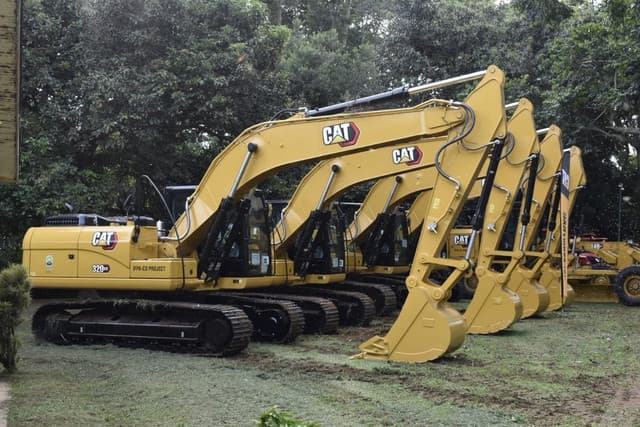
Uganda Wildlife Authority (UWA) has received a fleet of heavy road construction and maintenance equipment under the World Bank-funded Investing in Forests and Protected Areas for Climate-Smart Development (IFPA-CD) Project, marking a significant milestone as the multi-million-dollar initiative enters its final phase.
The newly acquired machinery, comprising three motor graders, four excavators, and four tractors with accessories, is expected to strengthen infrastructure development and improve accessibility across some of Uganda’s most important conservation landscapes.
According to UWA, the equipment will be deployed to key protected areas including Bwindi Impenetrable National Park, Kibale National Park, Queen Elizabeth National Park, and Kabwoya Wildlife Reserve.
UWA noted that "the machinery will support road and track maintenance, habitat management, invasive species control, construction of wildlife water dams during dry seasons, and enhancement of visitor experiences within Uganda’s national parks."
The Ministry of Water and Environment, which is leading implementation of the IFPA-CD project through the Department of Forestry Management, informing the public on X (formerly twitter) described the equipment acquisition as "a major investment in conservation infrastructure aimed at strengthening management of protected areas."
Implemented in collaboration with the Ministry of Tourism, Wildlife and Antiquities and the Uganda Wildlife Authority, the project seeks to promote sustainable management of forests and protected areas while increasing benefits derived from Uganda’s rich natural resources.
Funded by the World Bank, the project was approved by Parliament in April 2021 and was designed to address widespread environmental degradation, deforestation, climate change impacts, and declining economic productivity in project areas.
The initiative targets landscapes within the Albertine Rift and West Nile regions, covering 37 districts. It is being implemented in seven national parks, four wildlife reserves, 28 Central Forest Reserves, 16 refugee-hosting districts, and 14 additional non-refugee-hosting districts.
The protected areas benefiting from the project include Mgahinga Gorilla National Park, Bwindi Impenetrable National Park, Queen Elizabeth National Park, Rwenzori Mountains National Park, Semuliki National Park, Kibale National Park, Murchison Falls National Park, Toro-Semliki Wildlife Reserve, Katonga Wildlife Reserve, Kabwoya Wildlife Reserve, and Ajai Wildlife Reserve.
For UWA, the project has become a critical vehicle for advancing biodiversity conservation while improving infrastructure within conservation areas. Beyond road construction and maintenance, the project supports measures to address human-wildlife conflict through construction of fences, walls, gates, ranger posts, and staff housing.
The initiative also supports community livelihoods through collaborative forest and wildlife management arrangements and benefit-sharing schemes, with special attention given to vulnerable communities, including the Batwa.
Conservation experts note that improved infrastructure within protected areas is increasingly important for tourism development. Reliable road networks enable easier access to tourism sites, facilitate ranger patrols, support emergency response operations, and improve visitor safety and experiences.
Uganda’s tourism sector, which relies heavily on wildlife and nature-based attractions, continues to face challenges arising from poor road infrastructure in several conservation landscapes. Many protected areas become difficult to access during rainy seasons, affecting tourism activities and increasing operational costs.
The arrival of the new machinery is therefore expected to reduce dependence on hired equipment while enabling quicker maintenance of park roads and tracks throughout the year.
As the IFPA-CD project approaches completion, stakeholders say the investment leaves behind critical assets that will continue supporting conservation and tourism long after project closure.
The broader objective of the project has been to enhance forest and wildlife conservation for the benefit of local communities while sustaining livelihoods and contributing to Uganda’s economy. By improving management of forests and protected areas and increasing the benefits generated from them, the project seeks to demonstrate that conservation and development can advance together.
With climate change, habitat loss, and environmental degradation posing growing threats to Uganda’s natural ecosystems, the newly delivered equipment represents more than machinery. It symbolizes a renewed commitment to safeguarding the country’s forests, wildlife, and tourism resources for future generations.