UWA Takes Custody of over Eight Tonne Wildlife Contraband Seized at Entebbe International Airport Over 14 Years
Uganda Wildlife Authority (UWA) on Friday took custody of a vast archive of wildlife contraband that had been under the protection of the Uganda Police Aviation Unit at Entebbe International Airport for over 14 years, marking one of the most significant consolidated transfers of seized wildlife products in the country’s enforcement history.
The handover exercise, held at Entebbe International Airport, was presided over by Superintendent of Police Adam Kitatta, represented by SP Irene Mugoya, who formally relinquished custody of the exhibits on behalf of the Aviation Police. In his prepared remarks, Kitatta welcomed stakeholders to what he described as a crucial moment in Uganda’s wildlife law enforcement chain, noting that the exhibits had been securely held following joint operations with Uganda Wildlife Authority and other security agencies between 2011 and 2025.
“These exhibits have been in our custody for over ten years, having been confiscated at Entebbe International Airport between 2011 and 2025 through joint operations with UWA and other security agencies,” the statement read, as officers stood beside sealed storage units that had for years contained some of the country’s most sensitive wildlife crime evidence.
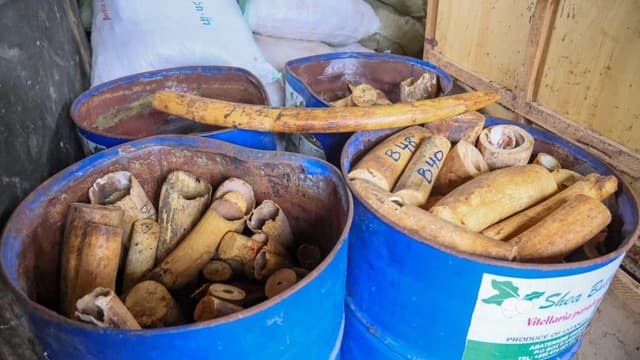
The contraband, weighing a total of about 8,000 kilograms, includes 6,017 kilograms of ivory in both raw and worked form, 2,030 kilograms of pangolin scales, 114 kilograms of rhino horns, and 8.8 kilograms of hippopotamus teeth, alongside other wildlife products such as skins, lion teeth, and ostrich eggshells. Some of the ivory, officials noted, had been ingeniously concealed in tins labelled as shea butter in a deliberate attempt to evade detection at one of East Africa’s busiest international airports.

The revelation underscored what enforcement officers described as the increasing sophistication of transnational wildlife trafficking syndicates, which continue to exploit regional trade routes and concealment techniques to move illegal wildlife products across borders.
Despite these methods, authorities pointed out that enhanced security measures at Entebbe International Airport, particularly the deployment of a canine unit in 2018, have significantly reduced the scale of similar seizures in recent years.
In his remarks, Kitatta expressed appreciation to the Uganda Wildlife Authority for agreeing to take over the exhibits, citing storage constraints at Aviation Police facilities where even designated storage areas had been repurposed over the years to accommodate the growing volume of seized materials. He also commended officers who had safeguarded the contraband throughout its long custody period, ensuring its integrity remained intact for judicial and investigative purposes.
“I also commend the joint teams from UWA and the Police who conducted the inventory exercise and confirmed that all exhibits are intact and properly accounted for,” the statement added, highlighting the meticulous verification process that preceded the handover.
Assistant Commissioner for Law Enforcement and Operations at UWA, Margret Kasumba, who oversaw the reception of the exhibits, thanked Aviation Police for their long-term stewardship of the contraband and reaffirmed UWA’s commitment to ensuring proper management of the evidence as investigations and legal processes continue. She noted that joint inventory checks had consistently confirmed that all items matched original seizure documentation, reflecting strong coordination between enforcement agencies.
Kasumba further emphasized the importance of inter-agency collaboration in the fight against wildlife crime, noting that “Uganda’s enforcement success is increasingly dependent on coordinated intelligence, surveillance, and prosecution efforts involving UWA, the Uganda Police Force, and other partners”. She added that since the introduction of the canine unit at Entebbe International Airport in 2018, there have been no major seizures of comparable magnitude, attributing this shift to strengthened surveillance and deterrence mechanisms.
Authorities have also observed that the improvement is largely due to heightened security measures that have discouraged traffickers from using the airport as a transit route for illegal wildlife products, even as syndicates continue to adapt their strategies across other porous entry and exit points in the region.
Uganda’s receipt of this massive contraband archive comes at a time when the country continues to grapple with a complex and persistent wildlife crime landscape, serving simultaneously as a source, transit hub, and interception point for international trafficking networks. While conservation gains have been recorded in some herbivore populations, flagship species such as elephants and lions remain under severe pressure from organised poaching, habitat loss, and escalating human–wildlife conflict.
Elephant ivory remains among the most sought-after illegal wildlife commodities, primarily destined for East Asian black markets, while pangolin scales continue to be heavily trafficked for traditional medicine and luxury trade. Hippo teeth are increasingly targeted as substitutes for ivory, placing additional pressure on already vulnerable populations, while rhino horns remain high-value targets for sophisticated transnational criminal networks operating across regional borders.

Uganda’s position between the Democratic Republic of Congo, South Sudan, and other neighbouring states has further entrenched its status as a key transit corridor, where porous borders are routinely exploited by organised syndicates.
Security experts have long warned that some trafficking routes are linked to armed networks and historically destabilised regions, where illegal wildlife trade has at times been used to finance armed activity.
According to the Wildlife Conservation Society (WCS), Uganda had registered an upsurge in wildlife product trafficking since 2010, and from 2015 to 2020 alone, a space of five (5) years, approximately 9960kg of ivory, 17.8kg of rhino horn and 1,374kg of pangolin scales were confiscated in the country.
The trade undermines Uganda’s tourism revenue earning and national security following a report by Enough and the Satellite Sentinel Projects indicating that the Lord’s Resistance Army (LRA) in Garamba heavily relies on elephant poaching and ivory trade to finance their operations (to buy arms, ammunition and food). Worse still, Uganda was listed among the ‘gang of eight’ alongside Kenya and Tanzania, in reference to countries that are doing little or nothing to curb illegal trade in ivory at the 16th meeting of the Conference of Parties (CoP16) of CITES (Convention in International Trade in Endangered Species of Fauna and Flora) in Bangkok.
However with heightened security and wildlife crime enforcement teams in most corners of the country, wildlife trafficking is slowly reducing with decrease in interceptions at the Entebbe International Airport.

Although, some traffickers continue to evolve concealment techniques, including hollowed-out timber packed with ivory and scales, wax-based encasements designed to evade detection equipment, and misdeclared cargo passing through commercial channels. These methods reflect the increasing professionalism of wildlife crime networks, which operate with cross-border coordination and logistical sophistication.
Despite these challenges, enforcement agencies have recorded notable interception successes in recent years, including large-scale ivory seizures in eastern Uganda under operations such as Operation Courtesy, which intercepted over 106 kilograms of cut tusks.
However, authorities acknowledge that underlying drivers such as poverty in communities surrounding protected areas continue to fuel participation in illegal harvesting activities.
Conservation officials continue to flag Murchison Falls and Queen Elizabeth National Parks as persistent poaching hotspots, where increasingly organised networks are suspected of operating behind layers of local intermediaries. These pressures, combined with habitat encroachment and human–wildlife conflict, continue to test Uganda’s conservation systems.
As UWA formally assumed custody of the long-held exhibits at Entebbe, officials described the moment not only as a logistical transfer, but as a reminder of the scale and persistence of wildlife trafficking networks operating in and through Uganda.
The seized contraband now enters the next phase of legal processing, even as enforcement agencies reaffirm their commitment to tightening surveillance and strengthening regional cooperation in the ongoing war against wildlife crime.