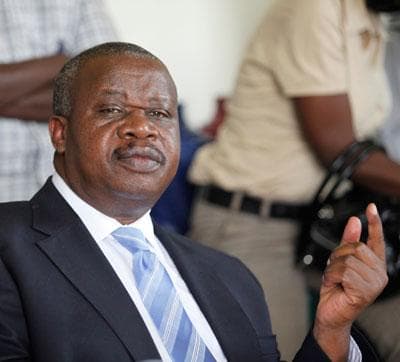
Return of the “Wetland Crocodile”: Otafiire Re-Enters Uganda’s Environmental Battlefield Two Decades Later
The re-appointment of Maj. Gen. (Rtd) Kahinda Otafiire as Uganda’s new Minister of Water and Environment, replacing Sam Cheptoris, has revived memories of one of the country’s most controversial, blunt and headline-grabbing periods in environmental governance.
More than 20 years after he first entered the then Ministry of Lands, Water and Environment in 2003, Otafiire returns to a sector now facing an even deeper crisis of biodiversity loss, wetland destruction, climate vulnerability, sanitation gaps and mounting dependence on international climate financing.
Back then, Uganda’s environmental sector was still largely centred around expanding safe water access, managing rapid urbanization and strengthening environmental institutions after years of instability. Today, the challenges are far more complex.
Wetlands continue disappearing at alarming rates. Forest cover remains under pressure from charcoal burning and agricultural expansion. Climate change has intensified floods, droughts and landslides. Peri-urban settlements continue swallowing fragile ecosystems while environmental activists increasingly accuse authorities of selective enforcement against encroachers.
Many environmental observers now believe Otafiire inherits a ministry struggling not only with ecological degradation, but also with conservation communication, public environmental education and digital visibility despite billions in international support flowing into Uganda’s climate and water sector.
His appointment immediately reignited debate about whether his aggressive style, famous public warnings and political fearlessness could once again shake the ministry into action.
During his earlier tenure between 2003 and 2006, Otafiire built a reputation as both a reformist and a political storm-maker.
In 2004, he oversaw the launch of Uganda’s first comprehensive Water Resources Atlas, a five-year data-driven national mapping project funded by UNICEF, SIDA and DANIDA. The atlas documented rural water resources across Uganda’s districts to guide government funding decisions and interventions in water-stressed areas such as Kotido.
Under his leadership, Uganda accelerated rural and urban water sector reforms. In August 2004, Otafiire announced that rural safe water coverage had increased to 57.2%, up from 26% in 1986.
Speaking at Nile Hotel in Kampala, he declared that Uganda’s rural population with access to clean and safe water had doubled in less than two decades.
He also became one of the strongest defenders of the National Water and Sewerage Corporation (NWSC) at a time when several state enterprises were collapsing or facing privatization pressure. Otafiire publicly argued that public institutions could still be commercially viable and efficiently managed.
But it was his fiery rhetoric and confrontational politics that often dominated headlines.
Perhaps no quote defined Otafiire’s environmental politics more than his now infamous wetland response after allegations emerged that he had improperly acquired land inside a Bugolobi wetland.
He angrily shot back:
“Am I a frog, or do I look like a crocodile to live in a wetland?”
The remark instantly became one of Uganda’s most memorable political quotes.
His war against wetland encroachment became even more dramatic in April 2006 when he ordered action against structures built in wetlands.
Addressing the parliamentary natural resources committee, Otafiire declared:
“I have already drafted a decree ordering the National Environment Management Authority to destroy all structures in the wetlands.”
“We are going to restore these wetlands in 30 days. This time we are not compromising over anyone. Whether it’s the residence of a minister or MP, it will be destroyed,” he added.
Otafiire directly linked environmental degradation to falling Lake Victoria water levels, telling legislators:
“We cannot say that the Lake Victoria water levels are falling yet there are people encroaching on wetlands. This is a total contradiction.”
However, even within his hardline stance, contradictions surfaced. While threatening mass demolitions, he acknowledged there could still be consideration for some industries and farms already established inside wetlands, particularly in areas such as Kabale.
At the time, wetland disputes around Kampala were already escalating. Reports had emerged alleging that former Kampala mayor John Ssebaana Kizito had sold parts of Nakivubo swamp, one of the wetlands protecting Lake Victoria from pollution. In Namuwongo-Kisugu, Meera Investments Limited, owned by businessman Sudhir Ruparelia, had reportedly acquired sections of wetland land, raising fears of evictions.
Otafiire’s bluntness continued even in personal confrontations involving wetland encroachers.
Commenting on Nyakana’s building in a wetland, he famously said:
“You very well know that the only animals that have got the license to live in wetlands are frogs, fish and crocodiles. Nyakana is neither a fish nor a crocodile. What was he doing there to complain that Otafiire has demolished his building? What was his house doing in the wetland? Is Nyakana a frog?”
Long before climate change adaptation became central to global development policy, Otafiire was already warning about financing gaps and institutional weaknesses in Uganda’s water and sanitation sector.
On April 29, 2004, while addressing the Twelfth Session of the United Nations Commission on Sustainable Development in New York, Otafiire acknowledged Uganda’s struggles in financing housing, sanitation and water infrastructure.
“My Government is concerned about enabling the poor access decent shelter. We are having difficulties attracting substantial private sector capital for large housing schemes,” he stated.
He further admitted:
“Government is faced with major challenges of establishing strong mechanisms for effective, efficient and sustainable delivery of water and sanitation services to the end users.”
Otafiire warned that inadequate financial and human resources were affecting implementation of reform strategies and investment targets.
He also pointed to inadequate physical planning and the pressures of rapid urbanization, arguing that sustainable water and sanitation services were essential for social and economic development.
In the same speech, he stressed Uganda’s commitment to implementing the Poverty Eradication Action Plan and global sustainable development commitments adopted in Johannesburg.
He told delegates that the financial and technical resources needed to attain the MDGs were enormous.
He added that developing countries like Uganda needed stronger partnerships and economic growth to sustainably provide services “beyond Aid.”
Two decades later, those same financing concerns remain deeply relevant.
Today, Uganda’s Ministry of Water and Environment heavily relies on foreign loans, grants and donor-backed projects to implement major infrastructure and climate resilience programs.
The World Bank funded the Integrated Water Management and Development Project worth $313 million to improve water access, sewerage systems and refugee-host community infrastructure.
France’s Agence Française de Développement committed €85 million toward water supply expansion in Greater Kampala. The African Development Bank finances the Strategic Towns Water Supply and Sanitation Project across several districts including Kamuli, Kayunga, Nakasongola and Bundibugyo.
Climate resilience projects have also expanded significantly. The Global Environment Facility finances Ecosystems-Based Adaptation projects restoring degraded wetlands and forests around river systems such as River Rwizi and River Sironko.
Germany’s BMZ supports cross-border peatland conservation initiatives between Uganda and Rwanda. Uganda also applied for $20 million from the Fund for Responding to Loss and Damage to strengthen resilience against floods and landslides.
Humanitarian and NGO funding has equally become central to the sector. World Vision Uganda alone committed UGX 160 billion in late 2025 toward mechanized water systems, borehole rehabilitation and sanitation facilities across 41 districts.
Yet despite this massive international financing, ministry officials continue warning that counterpart funding shortages from government are delaying projects, especially where compensation and land acquisition are required.
That concern mirrors warnings Otafiire himself made nearly two decades ago when he openly confronted district officials and ministry staff over donor accountability.
In September 2005, while opening the Fifth Joint Government-Donor Water and Sanitation Sector Review at Speke Resort Munyonyo, Otafiire expressed fury over misuse and diversion of donor resources.
He warned district leaders:
“I want to warn people of the districts attending this review that I am very, very unhappy. Very few districts have performed well. The money sent to you is not for meeting your other obligations.”
“Countrymen, this support is a result of sweat of taxpayers in the donor countries. We expect strict accountability. I will not hesitate to take extreme measures against anybody who doesn’t respect these resources,” he added, turning to ministry staff.
He threatened severe punitive measures and extreme actions against any individuals who failed to respect these resources and ensure strict accountability.
Otafiire also repeatedly confronted illegal settlement in forests and wetlands.
In March 2005, while speaking during national celebrations for International World Forestry, Water and Meteorological Day, he ordered people occupying forest reserves and wetlands to vacate or face arrest.
His environmental record, however, also carried policy inconsistencies.
In July 2005, Otafiire defended government’s decision not to immediately ban polythene bags, commonly known as buveera.
He argued:
“This issue has been raised before, but our position is to have a phased approach to the use of polythene bags spread out over a reasonable period of time.”
He said an abrupt ban could disrupt packaging and construction industries.
Yet by June 2006, as he was leaving office, Otafiire urged the ministry to continue pursuing a ban on buveera because of their environmental danger.
Throughout his tenure, Otafiire also faced recurring scrutiny over disputes involving institutional land such as Njeru Stock Farm and land under the National Agricultural Research Organisation (NARO), with critics questioning the intersection between political influence, land acquisition and environmental governance.
Now, two decades later, he returns to a ministry that has undeniably registered achievements but still faces overwhelming structural problems.
The Ministry of Water and Environment has expanded clean water access to millions of Ugandans and advanced climate resilience programs through REDD+ and Ecosystems-Based Adaptation initiatives. The ministry has promoted wetland restoration implemented by NEMA, sustainable charcoal production and strategic alignment with Uganda Vision 2040.
MAJOR CHALLENGES
Environmental degradation continues accelerating. More than 40% of Uganda’s wetlands have reportedly disappeared since 1994 due to urbanization and agricultural expansion. Budget constraints continue limiting enforcement, maintenance of rural water facilities and environmental regulation.
Population growth is increasing the cost and complexity of land acquisition for sanitation infrastructure and water systems. Poor sanitation coordination, weak faecal sludge management and low handwashing rates continue posing public health risks, especially in fast-growing peri-urban areas.
Many observers now see Otafiire’s return as both symbolic and political.
To supporters, he represents a hardline enforcer capable of confronting encroachers, corruption and bureaucratic complacency inside one of Uganda’s most donor-dependent ministries.
To critics, the environmental crisis facing Uganda today requires far more than forceful speeches and memorable quotes.
Still, history suggests Otafiire rarely returns quietly.
And as Uganda confronts worsening biodiversity loss, climate shocks, donor dependency and environmental conflict, the country may once again witness the return of one of its most combative environmental political figures, the "unbwogable" Kahinda Otafiire — a minister whose legacy remains permanently tied to wetlands, warnings, blunt language and the unforgettable question:
“Am I a frog, or do I look like a crocodile to live in a wetland?”