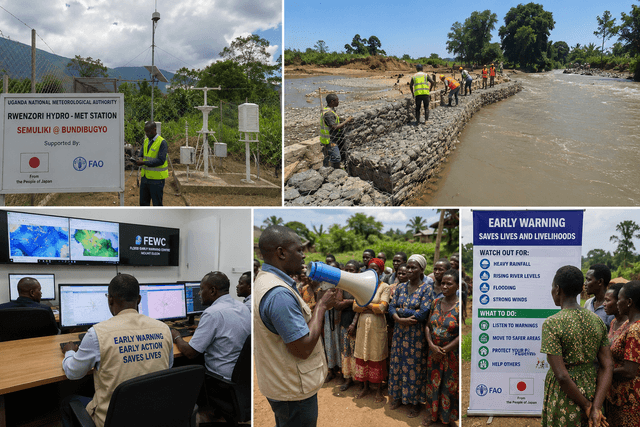
Uganda Braces for Drier June–August Season as Government Issues Climate Alert
The Government of Uganda has warned of generally drier-than-normal conditions across much of the country during the June to August (JJA) 2026 season, raising concerns over agriculture, water scarcity, livestock production, public health, and disaster risks.
While briefing journalists at the Uganda Media Centre on Friday, the Permanent Secretary at the Ministry of Water and Environment, Dr. Alfred Okidi, said the seasonal climate outlook indicates that most parts of the country are expected to receive near-normal to below-normal rainfall, with temperatures forecast to remain warmer than average.
According to the Ministry’s Department of Meteorological Services, the June to August period is traditionally dry over central, western, and parts of eastern Uganda, marking the end of the first rainy season and a harvesting period for seasonal crops. However, northern Uganda and some eastern areas usually continue receiving intermittent rainfall during the same period.
Dr. Okidi explained that the forecast has been influenced by several global and regional climate drivers, including warmer-than-normal Sea Surface Temperatures over the equatorial Central and Eastern Pacific Ocean — an El Niño tendency — which is expected to suppress rainfall across most parts of Uganda.
Other climate factors expected to influence the season include the Madden Julian Oscillation, which affects the timing and distribution of rainfall, as well as the positioning of the Inter-Tropical Convergence Zone and Congo Air Boundary, which could enhance rainfall over northern and eastern Uganda.
The ministry projects that central and western Uganda will experience prolonged dry spells and below-normal rainfall conditions for most of the season. Areas around Kampala, Wakiso, Masaka, Mpigi, Rakai, Kalangala, Mubende, Nakasongola, and surrounding districts are expected to experience isolated showers up to mid-June before dry conditions dominate for the remainder of the season.
In western Uganda, including the Rwenzori region, southwestern highlands, and cattle corridor districts such as Kiruhura, Isingiro, Kazo, and Mbarara, the dry season is expected to intensify after early June. The ministry warns that the anticipated dry conditions could negatively affect crop production, pasture availability, and water access for livestock.
Eastern Uganda, including Busoga and parts of the Mount Elgon sub-region, is expected to receive intermittent rainfall until mid-June before rainfall gradually reduces. However, northeastern districts covering Karamoja are likely to experience below-average rainfall throughout the season.
Northern Uganda is expected to receive occasional showers during June and parts of July, although rainfall amounts are still projected to remain near-normal to below normal overall.
The government says the expected weather conditions will have major implications on agriculture and food security. Reduced soil moisture, crop stress, flower abortion in coffee plantations, pest infestations, and declining yields are among the anticipated challenges. Livestock farmers have also been warned about increased heat stress, declining pasture, reduced milk production, respiratory diseases in poultry, and potential outbreaks of animal diseases.
However, the ministry says the dry conditions could also present opportunities for post-harvest handling, hay and silage preservation, road construction, de-silting of dams and fish ponds, and improved fish preservation through drying.
The ministry further warned of possible increases in bush fires, water scarcity, human and animal conflicts over resources, charcoal burning, heat stress in urban centres, and strong winds on lakes that may affect fishing communities.
To minimize losses, farmers have been advised to plant drought-tolerant and fast-maturing crop varieties, adopt irrigation and mulching practices, preserve pasture for livestock, strengthen animal vaccination and disease surveillance, and invest in water harvesting technologies.
Fishing communities have meanwhile been urged to avoid night travel on lakes, use life jackets, regularly monitor weather updates, and ensure boats are in good mechanical condition before venturing onto water bodies.
The Ministry of Water and Environment said it will continue providing regular weather updates and advisories to support planning and decision-making across key sectors of the economy.
The warning by Uganda’s meteorological authorities comes amid growing global concern over climate change.
A new report by the World Meteorological Organization (WMO) and the UK Met Office warns that global temperatures are likely to remain at or near record levels over the next five years.
The report says there is an 86 per cent chance that at least one year between 2026 and 2030 will become the hottest on record, while temperatures are also likely to temporarily exceed the critical 1.5°C threshold linked to extreme weather, food insecurity and displacement.