Uganda strengthens early warning systems as El Niño threat looms
KAMPALA — Uganda is scaling up early warning systems and anticipatory disaster response measures as climate change continues to drive increasingly severe floods, droughts, and heat stress across the country.
Speaking at a high-level meeting on Early Warning and Anticipatory Action for Resilient Livelihoods, Commissioner for Relief, Disaster Preparedness and Management in the Office of the Prime Minister, Davis Mwenyi, said climate change has become an immediate crisis requiring urgent and coordinated action.
“Climate change as you know is no longer a distant threat. It is a present crisis here with us that demands immediate and strategic investment,” Mwenyi said.
He warned that Uganda remains highly vulnerable to climate shocks such as floods and droughts, which continue to affect agriculture and food security. The country ranks 127th out of 193 in global climate disaster risk, while more than 66% of Ugandans depend on agriculture for their livelihoods.
“The cost of flood damage alone is estimated at over USD 62 million annually,” he added, noting that cities such as Hoima are increasingly experiencing heat stress days each year.
The meeting was convened by the Office of the Prime Minister in partnership with the Food and Agriculture Organization of the United Nations (FAO) and development partners, including support from the Government of Japan.
Representatives from the government of Japan reiterated Japan's commitment to strengthening Uganda’s disaster preparedness systems, emphasizing that investments in early warning infrastructure, hydrometeorological capacity, and anticipatory action are essential to reducing climate losses and protecting vulnerable communities. Japanese support under the ongoing partnership has enabled installation of hydro-climatic stations, strengthening of flood early warning centres, and technical knowledge exchange with Japan’s meteorological institutions.
FAO Representative to Uganda Ezana Kassa said the expected El Niño event in 2026–2027 underscores the urgency of preparedness.
“Experience from previous El Niño episodes reminds us that such events can result in severe flooding, displacement, disruption of agricultural production, and substantial economic loss. The question is not whether shocks will occur but whether we are ready to anticipate and act before they become disasters," Kassa said.
He stressed that early warning systems are more cost-effective than emergency response, noting that anticipatory action can significantly reduce losses when applied in time.

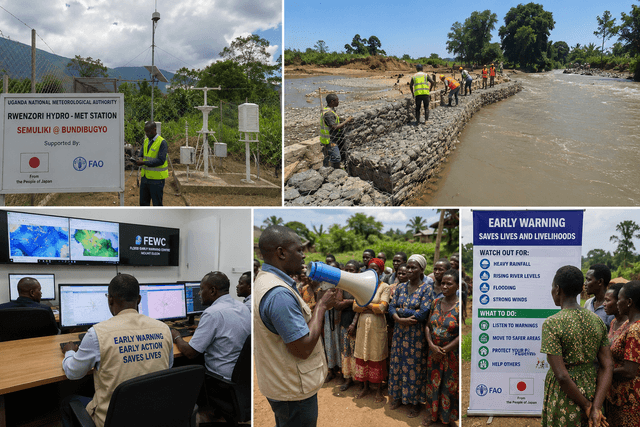
Under a Japan-funded FAO project titled Enhancing Flood Management with Integrated Early Warning Systems to Contribute to Women, Peace and Security, Uganda has strengthened flood preparedness in high-risk areas including Mount Elgon and the Rwenzori sub-region
The project has established 10 hydro-climatic stations and two flood early warning centres, enabling improved monitoring and forecasting. More than 100,000 people have received weather advisories, while about 5,000 households benefited from anticipatory flood protection measures such as riverbank stabilization along River Semuliki.
It has also trained 62 government staff in hydromet data use and gender-responsive anticipatory action, and supported technical exchanges with Japan’s meteorological agencies.
Officials said a survey on barriers to women’s participation in hydromet systems was conducted, alongside efforts to strengthen gender inclusion in disaster preparedness.
However, stakeholders warned that the interventions remain limited in scale and require sustained financing and stronger coordination to achieve nationwide impact.
Participants agreed that Uganda must shift from reactive disaster response to proactive risk reduction, especially as climate forecasts point to heightened El Niño risks in the coming years.
As El Niño conditions approach, stakeholders stressed that strengthening community resilience systems will be key to reducing impact at local level.
Communities in flood- and drought-prone areas are increasingly being reached through improved early warning dissemination channels, including radio alerts, weather bulletins, and local disaster committees that support farmers in adjusting planting schedules, relocating livestock, and protecting household assets before extreme weather events.
District disaster management structures under the Office of the Prime Minister are also expanding community sensitisation, evacuation preparedness, and local risk planning in high-risk districts.
At the same time, anticipatory measures such as riverbank protection works, early evacuation planning, and targeted support to vulnerable households are being promoted to reduce exposure before disasters occur.
However, experts cautioned that the approaching El Niño could intensify risks including displacement, crop loss, food insecurity, and disease outbreaks if preparedness gaps persist.
They emphasized that without scaling up financing, improving last-mile communication, and expanding early warning coverage, many vulnerable communities could remain exposed despite ongoing interventions.