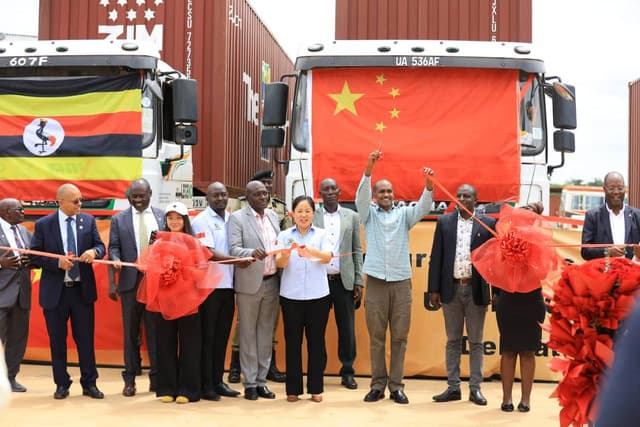
Uganda Flags Off First-Ever Processed Pineapple Exports to China
By ADMIN
Uganda has officially entered a new chapter in agro-industrialization after flagging off its inaugural export of processed pineapples to China, a milestone government officials, investors, and United Nations agencies described as a turning point from raw commodity exports to value-added agricultural trade.
The first consignment — 104 metric tonnes of canned pineapple processed by Deshiburg Fruits International Co. Ltd, was flagged off on Wednesday at the company’s processing facility in Luweero District.
The shipment marks Uganda’s first commercial export of canned pineapples to the People’s Republic of China and positions the country among emerging exporters of processed tropical fruit products to global markets.
Speaking at the ceremony, Uganda’s Minister of Agriculture, Animal Industry and Fisheries, Frank Tumwebaze, described the development as a major breakthrough in Uganda’s agro-industrialization agenda.
Tumwebaze said the factory, located within the Uganda-China Agriculture Cooperation Industrial Park, is the first dedicated canned pineapple processing facility in Uganda and has the capacity to process 500 tonnes of pineapples daily.
“This increases the demand for pineapples as a raw material and ends the perennial challenge of lack of market for our perishable agricultural produce,” Tumwebaze said.
He challenged farmers and local leaders to embrace what he termed “intentional farming” — producing specifically for existing industrial demand and export markets.
“The excuses of no markets for agricultural produce is no more with this revolution of agro-industrialisation,” he said, urging farmers to “produce, produce and produce more” while adhering to international standards.
The development has been hailed by the Food and Agriculture Organization as a practical example of food systems transformation driven by value addition.

FAO Country Representative Ezana Kassa said the export signifies Uganda’s transition from exporting raw agricultural commodities to exporting processed products capable of competing in demanding international markets.
“This occasion marks not only the dispatch of Uganda’s first commercial shipment of canned pineapple, but also a clear demonstration of the country’s transition from exporting raw agricultural commodities to exporting value-added products,” Kassa said.
According to FAO, value addition remains central to transforming agrifood systems because it expands opportunities for farmers, creates jobs across value chains, reduces post-harvest losses, strengthens resilience, and improves competitiveness.
Kassa noted that export readiness goes beyond production and requires compliance with international food safety standards, strong logistics systems, reliable supply chains, and effective public-private partnerships.
He particularly praised the out-grower model involving farmers from Luweero and neighboring districts, saying it ensures export growth translates into rural development and livelihood improvement.
The FAO official also linked the achievement to South-South and triangular cooperation between Uganda and China, saying FAO has supported technology transfer, deployment of Chinese experts, agro-industrial park development, and farmer capacity building.
“The Deshiburg investment stands as a practical outcome of these partnerships, demonstrating how South-South cooperation can catalyse investment, innovation, and market integration,” he added.
United Nations Resident Coordinator in Uganda Leonard Zulu described the export as “more than an export milestone,” calling it a story of transformation, dignity, and opportunity for Ugandan farmers.
“Behind these containers are thousands of Ugandan farmers and families whose livelihoods are beginning to change through access to reliable markets and value addition,” Zulu said.
He observed that for years, farmers in districts such as Luweero, Nakasongola, Nakaseke, and Kayunga suffered post-harvest losses and unstable prices, often watching produce go to waste or selling at extremely low prices.
“Today, that story is changing,” he said.
Zulu said the initiative directly contributes to several Sustainable Development Goals, including poverty reduction, food security, decent work creation, industrialization, and partnerships.
“What leaves this facility today is not just processed pineapple. It is a clear signal that Uganda is ready to add value, ready to compete globally, and ready to take its place in modern agro-industrial markets,” he said.
For the Chinese-backed investor Owen, the launch represented the culmination of years of international partnership and planning.
Deshiburg was formed through a partnership involving a Chinese canned food producer with 37 years of experience, the United States-based WW Group, Zhongyang Group with operations in Nigeria, and Linyi Atlantis Import & Export Co. Ltd.
The company chose Uganda because of its rich resources, stable investment environment, and enormous development potential.
Built in August 2025 with an investment of US$11 million, the factory directly employs hundreds of workers while supporting thousands of pineapple farmers through stable procurement ssystems.
Owen said the company is proud to be Uganda’s first modern factory dedicated to canned pineapple production, using the Smooth Cayenne pineapple variety and processing fruit without artificial preservatives.
“Our factory is operating at full capacity with a daily processing capacity of 500 tons of locally sourced pineapples,” he said.
The investor also unveiled plans for a large-scale agricultural science and technology industrial park integrating research, processing, warehousing, logistics, and demonstration farms.
Beyond canned pineapple, the company plans to expand into pineapple juice, frozen pineapple products, mango juice, avocado oil, canned maize, dried jackfruit, bananas, and canned jackfruit targeting global markets, especially China.
Owen called on Ugandan farmers to increase cultivation of high-quality pineapple varieties such as Smooth Cayenne and MD-2, pledging technical support, guaranteed orders, and stable markets.
He said the expansion aligns with Uganda’s national development priorities of agricultural value addition, industrial growth, and household income improvement.
The launch comes at a time when Uganda is increasingly pushing for agro-industrialization as part of efforts to boost export earnings, reduce agricultural losses, create jobs, and transition from subsistence to commercial agriculture.