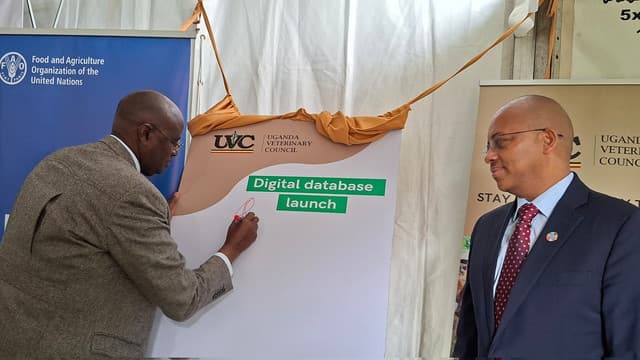
Uganda Moves to Flush Out ‘Quack’ Veterinary Practitioners with New Digital System
Uganda’s veterinary sector has entered a new digital era as government officially launches the Uganda Veterinary Council (UVC) Digital Database Platform, a system authorities say will tighten regulation, expose illegal practitioners and rebuild public trust in veterinary services.
But beyond the technology and speeches at the launch in Wandegeya, Kampala, one message dominated the event: the days of unqualified “quack” veterinary practitioners operating unchecked may soon become harder.
The new platform, comprising the UVC website and the National Veterinary Practitioners’ Database, is expected to strengthen registration, licensing, verification and monitoring of veterinary professionals across Uganda.
Officials say the system will reduce delays in registration and licence renewals while enabling farmers, livestock owners and the public to verify whether a veterinary practitioner is genuinely certified and licensed by the Uganda Veterinary Council.
Launching the platform, the Minister of State for Agriculture, Animal Industry and Fisheries/Animal Industry, Dr. Bright Rwamirama Kanyontore, described the initiative as “far more than a technological event.”
“It is a strategic institutional milestone. It reflects Uganda’s commitment to strengthening professional regulation, improving public service delivery, modernising governance systems and enhancing public trust in veterinary services,” Rwamirama said.
The launch was attended by officials from the Ministry of Agriculture, Animal Industry and Fisheries (MAAIF), the Food and Agriculture Organization of the United Nations (FAO), leaders of veterinary professional associations, development partners and veterinary practitioners from across the country.
Rwamirama congratulated the Uganda Veterinary Council, its leadership and partners for developing the system and specifically acknowledged FAO for the financial and technical support that made the project possible.
He also praised the support of the Bill & Melinda Gates Foundation through the Empowering Veterinary Paraprofessional Entrepreneurs Project.
At the centre of the reforms is growing concern over illegal and unqualified veterinary practitioners operating in communities and allegedly endangering animal health, livelihoods and public safety.
Dr. George Muhanguzi, a veterinary officer from Kazo District in Southwestern Uganda, described the launch as a turning point for the profession.
“As a Veterinary Practitioner, I am so glad because this is the first time I am seeing a Digital database for Veterinary Practitioners in Uganda,” he said.
“I strongly believe this is a step in the right direction and will restore public trust in veterinary professionals and veterinary services,” he added.
Muhanguzi warned that unqualified practitioners continue to pose serious dangers in the field.
“We have a problem of quack veterinary practitioners who masquerade as veterinary professionals yet they don’t have training in the same. These cause serious problems in the field for example misdiagnosis, inappropriate treatment protocols and unprofessional advice,” he explained.
According to him, many farmers struggle to distinguish between qualified and unqualified practitioners, often leading to mistrust toward the entire profession.
“They end up making conclusions that veterinary professionals are not helping us,” he said.
“With this system, a farmer or client will be able to check and see the status of a veterinary professional who is going to work on them. Once they find that the fellow is not qualified, they can decline their services. This will protect both the farmer and the veterinary profession,” Muhanguzi added.
The digital platform forms part of broader reforms under the Veterinary Practitioners’ Act, 2024, which significantly expands Uganda’s veterinary regulatory framework.
Previously, regulation mainly focused on veterinary surgeons. The new law now extends oversight to veterinary paraprofessionals, veterinary practice establishments, professional ethics, continuing professional development and veterinary education standards.
Rwamirama said the changing demands on veterinary services require stronger and more modern regulation systems.
The veterinary profession occupies a uniquely important place in Uganda’s national development agenda.
“Veterinary professionals are indispensable to livestock production, animal health and welfare, veterinary public health, food safety, trade and the livelihoods of millions of Ugandan households,” he said.
He added that veterinary regulation directly affects Uganda’s agricultural transformation agenda, public health security and participation in regional and international trade.
“Protecting animal health also protects public health, food safety, household incomes and national economic interests,” the minister said.

Government officials argued that manual systems and fragmented records can no longer support effective regulation in a rapidly evolving sector.
“Modern regulation requires digital systems. It requires accurate data. It requires efficient service delivery. It requires transparency. And it requires accessible communication,” Rwamirama stated.
According to officials, the new digital platform will improve registration efficiency, strengthen practitioner verification, improve oversight and increase public access to information.
Authorities also hope the system will support real-time management of Uganda’s veterinary workforce and improve accountability across the profession.
The Uganda Veterinary Council was commended for rapidly establishing governance structures, regulatory systems, stakeholder engagement processes and public sensitisation campaigns despite operational challenges.
Rwamirama particularly welcomed efforts to strengthen oversight of veterinary education and professional standards.
“A profession is only as strong as the competence, ethics and accountability of its practitioners,” he said.
He urged veterinary surgeons, paraprofessionals and veterinary establishments across Uganda to fully embrace the new framework by registering, obtaining licences and complying with professional standards and continuous professional development requirements.
“The establishment of a modern regulator is not intended to burden practitioners. It is intended to strengthen the profession. It is intended to protect those who practice ethically and competently. It is intended to remove illegal practice. It is intended to enhance public confidence,” he explained.
Government also acknowledged that implementing the Veterinary Practitioners’ Act will require stronger institutional support, staffing, financing and operational mobility.
Rwamirama admitted that the Council still faces challenges but pledged continued government engagement to strengthen the institution within available national resources.