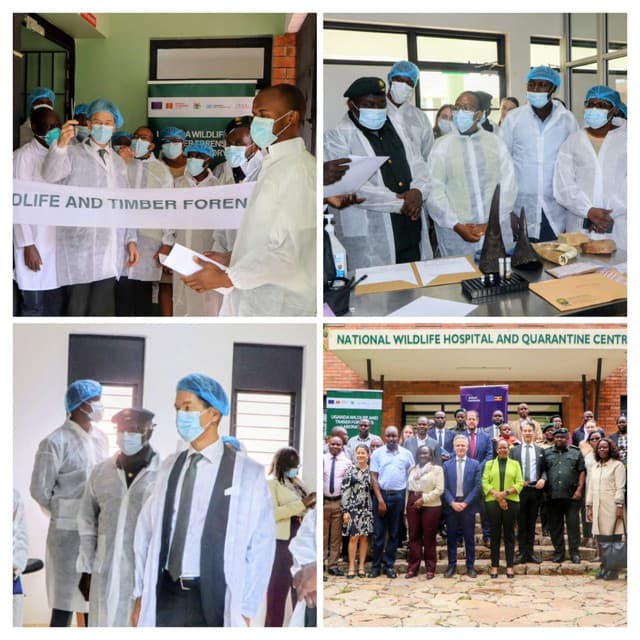
Uganda Opens Wildlife Forensics Laboratory to Strengthen Fight Against Environmental Crime
By our Reporter
The Uganda Wildlife Authority (UWA) has marked a major milestone in the fight against wildlife crime with the official opening of the Uganda Wildlife Forensics Laboratory at the Uganda Wildlife Education Centre (UWEC).
The state-of-the-art facility was handed over by the United Nations Office on Drugs and Crime with support from the TRACE Wildlife Forensics Network, and officially inaugurated by the Ambassador and Head of the European Union Delegation to Uganda, Jan Sadek.
Speaking at the ceremony, Sadek underscored the significance of the laboratory, noting: “This is much more than the inauguration of a building. It is a clear signal that wildlife and forest crime are treated as serious, organised crime and they will be investigated, prosecuted and punished.”
He highlighted that for years Uganda and the wider region lacked the forensic capacity to identify wildlife and timber species, despite illegal logging being a major transnational crime. Without scientific evidence, he said, many cases have failed in court, allowing criminal networks to thrive.
The new laboratory bridges that gap by providing advanced forensic capabilities, including timber DNA analysis to accurately identify species and trace their origin. It also operates under an international-standard Quality Management System to ensure that evidence produced is credible and admissible in court.
Mr. David Musingo, Commissioner for Community Conservation and Ex Situ Wildlife Services at UWA, emphasized the impact of the facility on conservation efforts.
“This laboratory strengthens our ability to link science directly to law enforcement. It gives Uganda the tools to not only investigate wildlife crimes more effectively but also to secure convictions that were previously difficult due to lack of credible evidence,” he said.
Supported under the EU–Denmark partnership and implemented through UNODC, the initiative reflects collaboration between UWA, the Ministry of Water and Environment, and international partners. Beyond infrastructure, the project also invests in training and capacity building to ensure long-term sustainability.
Early results are already emerging, with cases that previously stalled now progressing to court and resulting in convictions. In the coming months, the laboratory will fully operationalise timber DNA analysis, further strengthening Uganda’s ability to combat forest crime.
The official opening was attended by key stakeholders, including the Permanent Secretary of the Ministry of Water and Environment, Alfred Okot Okidi, representatives from the Embassy of Denmark, UNODC, TRACE, the British High Commission, and members of the judiciary, including Her Worship Gladys Kamasanyu.
The establishment of the Uganda Wildlife Forensics Laboratory marks a critical step in reinforcing the rule of law, protecting biodiversity, and safeguarding Uganda’s natural heritage for future generations.